
Agentic Pharma — est. 2026

Intelligence Drives Drug Development

By Sridhar Byrappa // 7-23-26

More drugs are being discovered with AI than ever before, but every single one must still undergo clinical trials to be approved. Therein lies the true bottleneck for pharmaceutical companies.

How drugs are tested and brought to market has not meaningfully changed in decades. The last major shift occurred when the industry moved from paper to electronic records; since then, progress has been merely incremental.

The core constraints of clinical development have remained rigid. On one end, pharma companies invest heavily in drug discovery, yet pay far less attention to modernizing how clinical trials are run. On the regulatory end, rules have remained static because the industry hesitates to challenge the status quo.

With the rapid maturation of AI, this logjam must be broken. Here is how we envision the future of clinical trials:
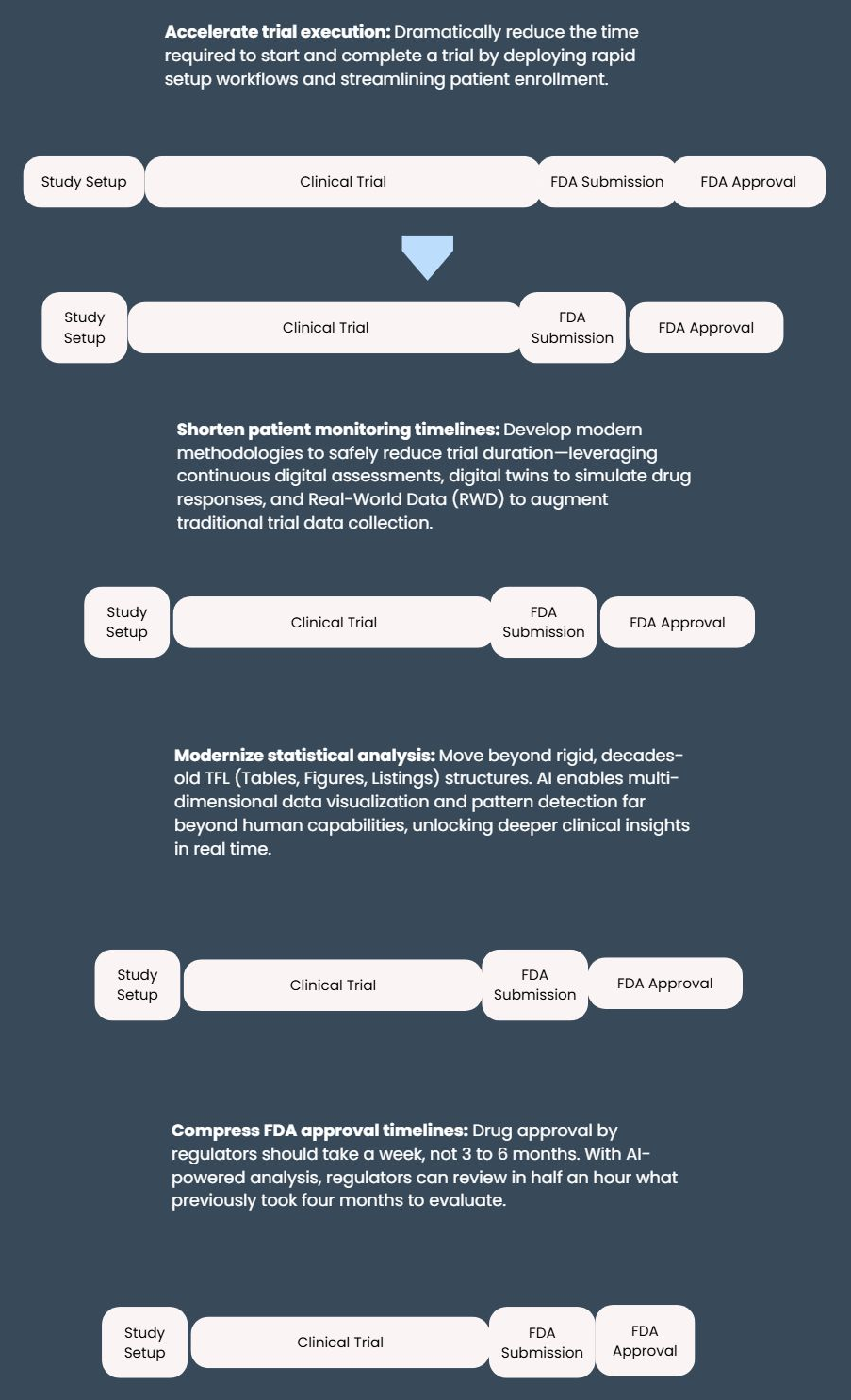
Accelerate trial execution: Dramatically reduce the time required to start and complete a trial by deploying rapid setup workflows and streamlining patient enrollment. Shorten monitoring timelines: Develop modern methodologies to safely reduce trial duration—leveraging continuous digital assessments, digital twins to simulate drug responses, and Real-World Data (RWD) to augment traditional trial collection. Modernize statistical analysis: Move beyond rigid, decades-old TFL (Tables, Figures, Listings) structures. AI enables multi-dimensional data visualization and pattern detection far beyond human capabilities, unlocking deeper clinical insights in real time. Compress FDA approval timelines: Drug approval by regulators should take a week, not 3 to 6 months. With AI-powered analysis, regulators can review in half an hour what previously took four months to evaluate.